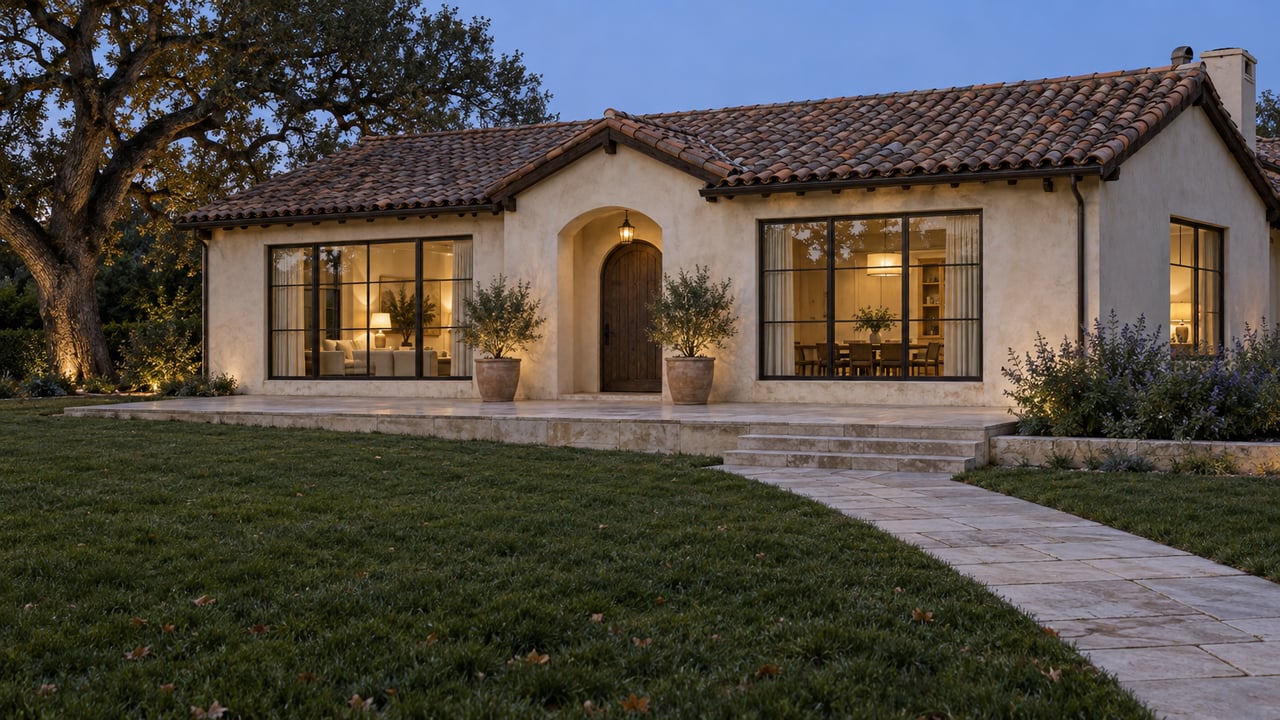
Scroll through listings for vineyard and ranch parcels around Santa Ynez this year and you'll notice how often well details are highlighted: two producing wells, a 300 gallon-per-minute ag well, or a flow rate presented like square footage. These figures are useful, but they do not answer every question about a well.
A flow-rate figure answers how much water comes out of the ground. It does not answer the question that actually determines your closing timeline, your permitting cost, or whether you can drill a second well when the first one falls short: which of three overlapping government agencies has jurisdiction over the ground your well sits in. That answer depends on a line you cannot see on a plat map, and it can put two nearly identical parcels a few hundred yards apart on completely different tracks.
The line you can't see on a plat map
The Santa Ynez River Valley Groundwater Basin isn't managed as one basin. Under California's 2014 Sustainable Groundwater Management Act, it was split into three separate Groundwater Sustainability Agencies: the Eastern Management Area, which covers the Solvang and Santa Ynez area, the Central Management Area around Buellton, and the Western Management Area toward Lompoc, according to the Santa Barbara News-Press. Each GSA reviews new well applications independently, with its own fee schedule and its own technical staff.
But jurisdiction doesn't stop at the management-area boundary. It also depends on what's happening underground. In a 2023 review of a well application for a Santa Ynez Valley property known as Rita's Crown Vineyard, the reviewing engineer determined the proposed well was located in what's called the River Alluvium subarea and was therefore not within GSA jurisdiction at all, according to the Western Management Area review packet. A different well application from the same period, for a parcel held by the Willett 2016 Family Trust, went through the full Western Management Area review process and was approved as a replacement well under the standard conditions.
Same basin. Same general part of the valley. Two entirely different permitting paths, decided by which subarea the well happens to sit over.
That's the mechanism buyers miss. A well isn't a fixed asset that transfers cleanly with the deed. Its regulatory status depends on geology and jurisdiction, and those two things don't always line up with the property lines on a title report.
What changed in 2022 for well permitting
For most of the valley's history, drilling or replacing a well was close to an over-the-counter transaction at the county building. That changed in 2022, when the Santa Barbara County Board of Supervisors tightened the rules for approving new water wells in response to a statewide executive order. Under the new ordinance, a licensed hydrogeologist, or a licensed geologist with hydrogeological expertise, has to sign off on the relevant GSA's attestation that a new well won't reduce the productivity of nearby wells before the county will issue a permit.
At the time the ordinance passed, county data showed roughly 110 well permits were being issued annually across the county's basins in the prior five years, and about 57 percent of those would have fallen under the new review requirement. That means a majority of well permits issued across the county's basins in the prior five years would have fallen under a process that didn't exist a few years earlier, and many sellers describing an "existing well" on a listing sheet today are describing something that was permitted, or replaced, under an entirely different set of rules than what a buyer will face if that well ever needs work.
Three agencies, three different price tags
The fee schedule makes the jurisdictional split concrete. Here's what a written well verification currently costs, by management area:
| Management Area | Towns Covered | Well Verification Deposit |
|---|---|---|
| Eastern (EMA) | Solvang, Santa Ynez | $2,200, according to the Eastern Management Area |
| Central (CMA) | Buellton | $1,200, according to the Central Management Area |
| Western (WMA) | Lompoc area | $1,200, according to the Western Management Area |
If your search is centered on Santa Ynez or Solvang specifically, the well verification step costs nearly double what it costs for an otherwise identical parcel near Buellton, purely because of which GSA has authority there. That's not a reflection of aquifer depth, well design, or anything a driller controls. It's an administrative boundary, and it belongs on the list of numbers buyers ask about before they get emotionally attached to a property.
A full lake doesn't reset the clock
As of mid-July 2026, Lake Cachuma sat at about 92 percent of capacity, and the Santa Ynez River Water Conservation District has said it is not planning a water rights release downstream of the lake during 2026. On the surface, that reads as a good year for water in the valley, and it's tempting to assume a full reservoir means the well permitting process loosens up.
It doesn't work that way, because the reservoir and the groundwater basin are managed on separate tracks. Lake Cachuma is surface water administered by the U.S. Bureau of Reclamation and the Cachuma Operation and Maintenance Board. The three GSAs approved 20-year Groundwater Sustainability Plans in January 2022, according to the Santa Barbara Independent. In fact, the oversight infrastructure is getting more detailed regardless of how wet the year is. The three GSAs were awarded a $5.5 million grant from the California Department of Water Resources in 2024, earmarked in part for well extraction metering and monitoring improvements. A wet year fills the lake. It doesn't reduce the paperwork on a new well application.
What this changes at the escrow table
None of this means vineyard and ranch land in Santa Ynez Valley is a bad bet. The broader valley averaged roughly a $2.64 million sale price this past spring, and trophy vineyard estates in places like Happy Canyon of Santa Barbara trade in the mid-to-high eight figures on scarcity and vineyard value alone. Buyers at every price point in that range are making decisions on land where water is the whole story, and the diligence doesn't scale down just because the number on the well spec sheet looks reassuring.
Before you write an offer on a property with a private well, ask for three things that clarify the well's status and history. First, ask which management area the parcel falls in and whether the well sits in a subarea like the River Alluvium that may fall outside GSA jurisdiction entirely, since that changes both the cost and the timeline if the well ever needs replacing. Second, ask for the GSA well verification letter. Third, ask for the owner's groundwater production reporting history. The July through December 2025 cycle came due January 31, 2026, according to the Santa Ynez River Water Conservation District. If that filing history is unavailable, clarify the well's registration and reporting status before closing.
The gallons-per-minute number on a listing tells you the well works today. It says nothing about the costs or requirements that may apply if the well needs replacement or expansion, or if a neighboring parcel drills a new well. Those questions depend in part on the well's location, so include them in your due diligence.
Frequently asked questions
Does a wet year like 2026 make it easier to permit a new well in Santa Ynez Valley? No. Lake Cachuma's storage level is managed separately from the groundwater basin. New well applications are still evaluated regardless of how full the reservoir is in a given year.
What is the River Alluvium subarea, and why does it matter for a well? It's a specific geologic zone recognized in at least one GSA's well review process as falling outside that agency's jurisdiction. A well confirmed to sit in this subarea can bypass the standard hydrogeologist verification requirement entirely, while a well a short distance away, over a different part of the aquifer, may need the full review.
Are the well verification deposits the only cost involved in permitting a new well? The deposits, ranging from $1,200 to $2,200 depending on the management area, cover the GSA's written verification. They're separate from the county's own well construction permit fees and from the cost of hiring a licensed hydrogeologist to prepare the underlying analysis.
Water is the first diligence item on any Santa Ynez Valley parcel, not the last. If you're evaluating vineyard, ranch, or equestrian land in the valley and want a clear read on what a specific parcel's well situation actually means for your timeline and budget, Kris Johnston and the team at Central Coast Landmark Properties can walk the ground with you. Request a private consultation and market assessment before you write an offer.
This article is general information, not legal, tax or financial advice. Consult a qualified professional about your situation.