Since the 2012 and 2013 vintages, the grower-producers of Ballard Canyon have put their estate Syrahs in a custom bottle with the words BALLARD CANYON raised in the glass around the shoulder, according to the Ballard Canyon Winegrowers Alliance. The name went onto glass rather than onto a grape invoice, and that choice explains a lot about vineyard economics in the canyon north of Solvang. Read against the 2025 public grape data, the fruit from a planted acre in this part of Santa Barbara County pays the vineyard's operating bill and comes up short of its full cost of production. The appellation earns its premium through the bottle and through the buyers who want this particular fruit. Tonnage sold on the open market does not carry it.
For anyone weighing a vineyard property along Ballard Canyon Road, that changes the question. The vines matter less than who turns them into wine.
A small appellation built around one grape
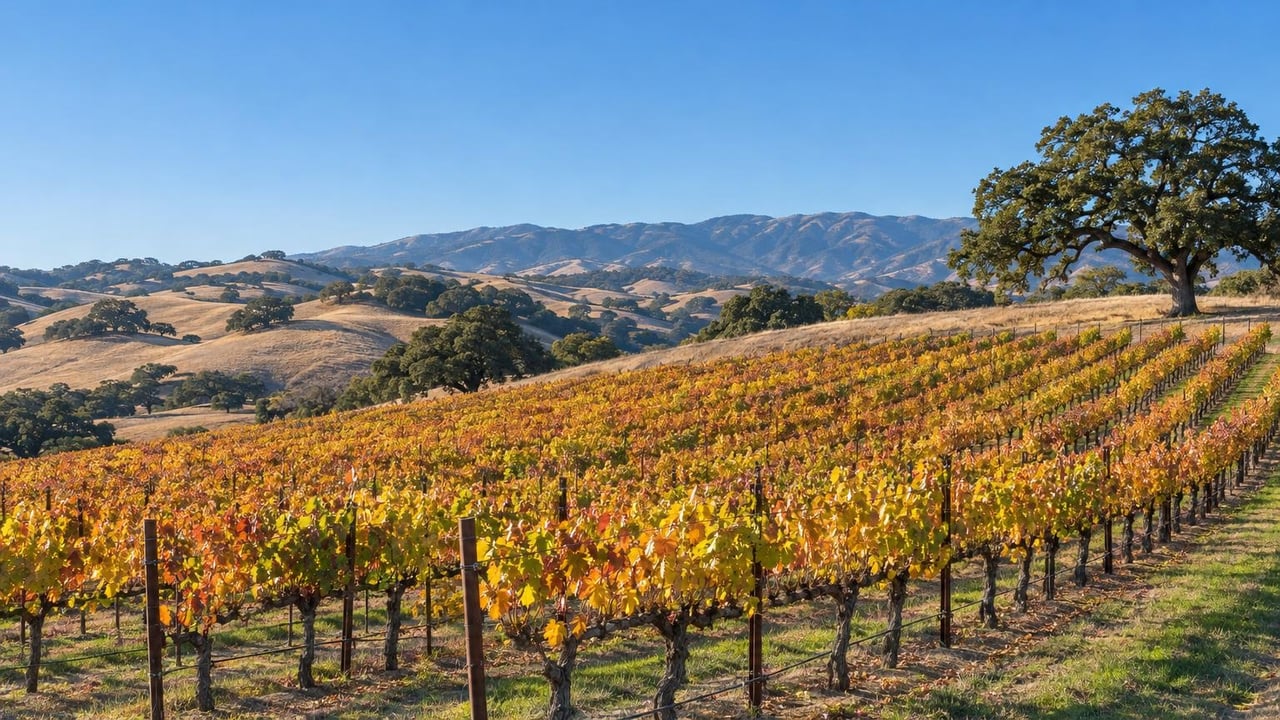
The Alcohol and Tobacco Tax and Trade Bureau published the Ballard Canyon AVA on October 30, 2013. Vintner Michael Larner led the petition, and Wes Hagen researched and wrote it. The growers' group puts the appellation at 7,700 acres, about 10% of the Santa Ynez Valley AVA, with only 550 acres planted. The Santa Barbara Independent's 2013 report on the approval gave the area as 7,800 acres. Syrah covers more than half the planted acreage, and Grenache, Viognier, Roussanne and other Rhône varieties account for another 30%.
Farming here goes back further than the appellation. Gene Hallock founded Ballard Canyon Winery in 1974 on land that is now Rusack Vineyards. The Stolpman, Beckmen, Harrison, Larner and Saarloos families planted in the 1990s, Jonata and Tierra Alta followed, and later Kimsey, Jorian Hill and Rancho Boa Vista planted with a focus on Syrah and Rhône varieties. The Alliance currently lists 17 vineyard members, a provisional count that depends on dues, and nine of them produce and bottle wine.
Put the canyon's acreage beside the county's and the scale becomes clear. More than half of 550 planted acres is over 275 acres of Syrah. Santa Barbara County's 2025 Crop and Livestock Report counted 835 harvested acres of Syrah in the whole county for the 2025 crop year. One north-south canyon holds a large share of the county's Syrah, so the county's Syrah numbers come close to describing Ballard Canyon's own crop.
The county earned more from fewer acres
Harvested wine-grape acreage in Santa Barbara County fell from 12,126 acres in 2024 to 10,649 in 2025, and total wine-grape value rose from $70.857 million to $87.793 million over the same two crop years. KSBY reported the increase as 24%, and county agriculture officials credited higher yields per acre and continued demand for high-quality fruit.
The rest of California moved in the opposite direction. The USDA's California grape acreage summary, released April 22, 2026, estimated statewide wine-grape acreage at 540,000 in 2025, down from 580,000 in 2024, with more than 21,000 acres removed in the previous 12 months. The acres that survived a statewide pullback were the ones buyers wanted. Santa Barbara County's 2025 figures suggest its remaining vineyards belong in that group. They do not suggest that a vineyard planted to any variety on any slope will find a buyer for its fruit.
The math on one acre of Syrah
The county report gives each variety's yield and price for the 2025 crop year. Syrah averaged 3.28 tons per acre at $2,189 per ton. Pinot Noir brought $3,167 per ton and Chardonnay $1,884. Multiply yield by price and an average acre of county Syrah grossed about $7,180 in 2025. The report states that its figures are gross values that leave out production costs.
The federal grape survey uses a different method and lands on a higher number. The USDA and CDFA 2025 final Grape Crush Report shows weighted average grower returns, on grapes purchased on a delivered basis in District 8, of $2,798.86 per ton for Syrah, $2,393.27 for Pinot Noir and $1,660.74 for Chardonnay. District 8 covers San Luis Obispo, Santa Barbara and Ventura counties. So one official series puts Syrah well below Pinot Noir and the other puts it above. The gap of more than $600 a ton between the two Syrah figures is a reminder that "the price of Syrah" depends on whose fruit, which buyers and which counties are in the sample.
For costs, the closest current public benchmark is the UC Davis 2025 sample cost study for Cabernet Sauvignon in Paso Robles-East, based on December 2025 input costs. It models $5,464 per acre in operating costs, $11,110 per acre in total cost once a vineyard is in production, and $28,475 per acre to establish a vineyard through its third year. That is a different county and a different grape, so it shows the order of magnitude rather than a Ballard Canyon budget.
| Per acre, 2025 crop year | At 3.28 tons/acre | At 3 tons/acre |
|---|---|---|
| Gross at county Syrah price, $2,189/ton | about $7,180 | about $6,570 |
| Gross at District 8 Syrah return, $2,798.86/ton | about $9,180 | about $8,400 |
| UC Davis Paso Robles-East operating cost | $5,464 | $5,464 |
| UC Davis Paso Robles-East total cost in production | $11,110 | $11,110 |
The three-ton column comes from Ballard Canyon itself. When Noozhawk covered the 2025 vintage, Jonata's Matt Dees said projected tonnage was on target at up to three tons per acre, in a year described as high quality and generally lower yielding. Every combination in the table clears the operating line, and none reaches the total-cost line. On these numbers, an acre of Syrah sold by the ton keeps the vineyard farmed. It does not repay the full cost of owning and running it.
Where the premium shows up
Nine of the Alliance's 17 vineyard members produce and bottle their own wine, and the custom Ballard Canyon bottle has carried estate Syrahs since the 2012 and 2013 vintages. A vineyard that sells its Syrah as estate wine under a Ballard Canyon label captures value at the bottle, and the per-ton figures above never record it.
The other route is a long buying relationship with a winery. The Alliance notes that Kaena gets most of its Rhône grapes from Tierra Alta, and Noozhawk reported that Kaena's winemaker estimated buying more than half of that vineyard's crop each year. A named winery that comes back for the same blocks every year is a better sign of appellation value than any county average, because it reflects the price this vineyard's fruit actually brings.
The 2026 market makes those relationships matter more. Wine Business reported on October 9, 2026 that California's spot market found homes for nearly all uncontracted fruit this year, but at average prices or below, with fewer contracts on offer and buyers looking for bargains. Closer to home, Noozhawk's November 2026 harvest report described small clusters across Santa Barbara County after one of the warmest winters on record, and quoted Ken Brown Wines winemaker Ben Van Antwerp: "A lighter crop is good with the state of the market." The Santa Barbara Independent noted in August that Ballard Canyon, one of the warmer areas, was running behind the coolest parts of the county. We covered the same pattern on the valley floor in why the record-early harvest ran closest to normal around Santa Ynez. In a light-crop year with soft spot prices, a contracted Ballard Canyon block and an uncontracted one are two different assets, even when the vines look the same.
What this changes in a Ballard Canyon purchase
When a planted vineyard here comes to market, the clearest evidence of its farming value is the paper. That means grape purchase agreements with dates and terms, the names of the wineries that have bought the fruit and for how many vintages, and the estate label history if the property bottles its own wine. Yield records by block matter as well, because the gap between three tons and 3.28 tons is several hundred dollars an acre at 2025 prices. A seller with this file in hand is selling a business with a track record. A seller without it is selling land with vines on it, and the price should reflect that.
The table also helps a buyer think about the canyon's unplanted ground. The growers' group calls the gap between 7,700 acres and 550 planted acres room to grow. At the UC Davis benchmark of $28,475 an acre to establish, and with fruit sold by the ton falling short of total cost in 2025, new planting pays off through a label or a committed buyer. A higher tonnage price is unlikely to do it alone. Properties enrolled in agricultural preserve contracts have their own long timelines, covered in our post on the Williamson Act clock in Los Olivos vineyards, and sellers can find preparation notes in preparing a Los Olivos vineyard or estate for sale.
A few questions buyers ask
Is Ballard Canyon part of Solvang? The appellation sits between Solvang and Los Olivos inside the larger Santa Ynez Valley AVA, and Ballard Canyon Road runs north out of Solvang. Our Solvang neighborhood page covers the town itself.
Does the Ballard Canyon name raise grape prices above the county average? The county and federal grape reports publish prices by county and district, with no separate line for Ballard Canyon. A Ballard Canyon premium shows up in individual grape contracts and in estate bottlings, which is why those documents carry so much weight in a sale.
When will 2026 grape prices be published? CDFA's schedule puts the preliminary Crush Report for the 2026 crop year on March 15, 2027. The county's report on the 2025 crop came out in late June 2026.
The figures in this post are public benchmarks shared as general information. They are not financial or tax advice, and anyone evaluating a specific vineyard should confirm its economics with their own agricultural, tax and financial advisors.
If you are weighing a Ballard Canyon vineyard, the contracts, block records and label history tell you more about its value than the vines alone. Central Coast Landmark Properties can review that file with you privately and set it against the canyon's recent record. Request a private consultation and market assessment.